
- Published on
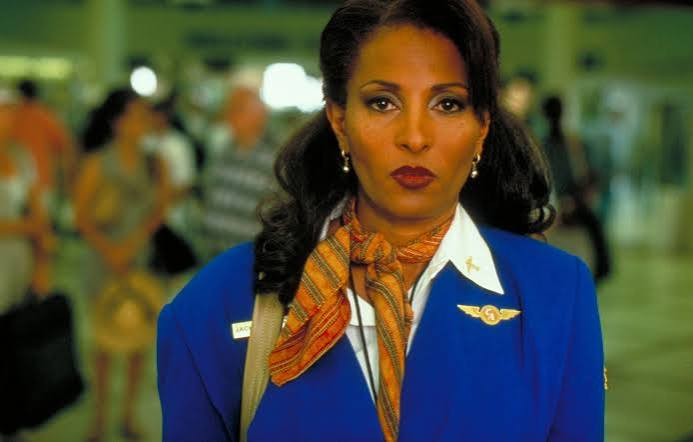
Before Jackie Brown says a word, Bobby Womack is already singing about survival.
She moves through Los Angeles International Airport in her Cabo Air uniform while Across 110th Street plays. We do not yet know about Ordell, the police, her criminal record or the money. The song cannot tell us Jackie’s history, but it frames our first encounter with her. Survival is in the air before we know what she has survived.
And then there is Pam Grier.
She gives Jackie gravity largely by refusing to perform importance. She does not rush her reactions, fill every silence or make every thought immediately available to us. Jackie often seems to receive information first and answer only after she has decided what to do with it. Grier’s stillness makes us watch her.
Even fear does not make Jackie disappear. She can be frightened without becoming small. When other characters become louder or more aggressive, Grier rarely competes with their energy. She lets them reveal themselves against her restraint.
Jackie seems fully located inside herself. She enters the film not as someone waiting for the story to make her important, but as someone whose life was already in progress when the camera arrived.
How do you write an intelligent character without announcing that she is intelligent?
Hollywood usually makes intelligence visible. The detective explains the clues. The lawyer delivers the devastating argument. The criminal unveils the master plan. Intelligence performs for us, and we are left in no doubt that we are watching an exceptional mind at work.
Jackie Brown does something more difficult.
It lets us recognize intelligence the way we often recognize it in life: through the quality of a person’s decisions.
Jackie is forty-four years old. She has spent almost twenty years waiting on passengers and flown seven million miles. After an earlier arrest, the best job she could get was Cabo Air. She makes sixteen thousand dollars a year, with retirement benefits that, as she puts it, “ain’t worth a damn.”
Seven million miles.
Sixteen thousand dollars.
Jackie has accumulated experience without accumulating security. She has extraordinary physical mobility and very little economic mobility.
The film does not give Jackie a superpower. It gives her mileage.
That distinction matters. Jackie’s vulnerability does not make her intelligent. It makes accurate judgment necessary. Her job is precarious. Her criminal record has already narrowed her choices. Another conviction could destroy what little security she has, and one wrong reading of Ordell could get her killed.
Other people have greater margins for error.
Jackie does not.
She cannot afford many illusions.
Ordell sees someone he can frighten. The police see someone they can pressure. Both sides assume Jackie will cooperate because she has nowhere else to go. They confuse her lack of options with a lack of intelligence.
Jackie lets them.
That may be the invisible writing decision that makes her unforgettable.
Most screen heroes become powerful by revealing what they can do. Jackie gains an advantage by concealing it. She does not hurry to correct other people’s assumptions about her. Being underestimated gives her room to maneuver because people make plans for the Jackie they think they understand.
She does not interrupt their confidence.
She studies it.
When Ordell comes to Jackie’s apartment after she has been released from jail, she knows why he is there. Beaumont, another of his employees, has already been murdered after being arrested. Jackie has every reason to believe she may be next.
But she has taken Max Cherry’s gun.
The scene does not suddenly transform her into an action hero. She does not overpower Ordell or deliver a triumphant speech. She does something more interesting: she changes his calculation.
“Way I see it, me and you only got one thing to talk about. What you willing to do for me?”
The threatened woman does not ask what Ordell intends to do to her.
She asks what he is willing to do for her.
In one sentence, the person he came prepared to eliminate becomes someone he must negotiate with.
Jackie understands that appealing to Ordell’s mercy would be useless. She cannot make him kinder. She cannot make herself physically stronger than he is. What she can do is alter his reasons for acting.
She has to become more useful alive than dead.
This is Jackie Brown’s particular kind of intelligence. It is not intellectual display. It is social reading combined with timing. She watches people closely enough to understand what they want, what they are likely to do and what they are prepared to believe.
She reads character before she constructs strategy.
And the film itself gives us a remarkably concise description of why that matters. Ordell says of Melanie:
“You can’t trust Melanie. But, you can always trust Melanie to be Melanie.”
It sounds like a joke about an unreliable woman, but it contains something close to a governing principle of the film. People do not have to be trustworthy to be predictable.
Jackie does not need Melanie to become reliable. She does not need Ordell to become less suspicious or Max to become less decent. She does not need to control everyone around her. She can build around the likelihood that they will remain recognizably themselves.
More importantly, she understands not only Melanie but Ordell’s understanding of Melanie. If something goes wrong around a woman Ordell already distrusts, Jackie knows where his suspicion is likely to travel.
This is not the intelligence of a chess master who has calculated every move to the end. Jackie’s plan enters a world populated by people, and people create accidents. She cannot know precisely what everyone will do.
Her intelligence is more adaptive than omniscient.
She creates favorable conditions, reads what happens next and keeps moving.
Ordell wants control.
The police want their case.
Jackie wants options.
And she understands something they don’t: hers are disappearing.
When she eventually tells Max what truly frightens her, the entire character suddenly comes into focus. She has flown seven million miles. She has spent nearly twenty years serving other people. Her salary is poor, her retirement benefits are nearly worthless, and another conviction could destroy the fragile structure she has managed to preserve.
“I got nothing to start over with. And that shit is scarier than Ordell.”
There is the key to the film.
Jackie is not primarily afraid of a criminal.
She is afraid of a future.
Ordell represents immediate danger. What frightens her more is something slower and less cinematic: reaching a point in life where experience no longer creates opportunity, where another mistake could leave her with neither enough money nor enough time to begin again.
Her fear does not disappear before she becomes effective.
She thinks from inside it.
Jackie remains frightened because she sees the danger accurately. Her composure is not proof that she feels safe. It is what she does with the knowledge that she isn’t.
She is dangerously lucid.
That is why the money matters.
It isn’t greed.
It is the ability to choose.
Jackie is trying to avoid a future in which every decision will be dictated by necessity. She doesn’t want extravagance. She wants enough leverage to refuse “whatever I can get.”
This is also why Pam Grier is such essential casting. Jackie occupies a precarious position in almost every system around her, yet Grier never allows precariousness to become insignificance. Cabo Air can assign Jackie a salary. The police can assign her a legal status. Ordell can assign her a function. None of those measurements seems adequate to the woman we are watching.
In one playful exchange, Max tells Jackie that, apart from perhaps having worn an afro, she probably looks much as she did at twenty-nine. Jackie points out that her body has changed. Max sees nothing wrong with that.
The film does not ask Jackie to recover her younger self. The years since twenty-nine belong to her too.
Lucille Clifton, in What the Mirror Said, describes a woman as having “a geography of your own.”
Ordell knows Jackie as a courier. The police know her as a suspect and informant. Cabo Air knows her as an employee. Each knows one coordinate and mistakes it for the whole territory.
Jackie is the map.
Max Cherry comes closer than anyone else to resisting that mistake. He recognizes Jackie’s predicament without reducing her to it. In a film filled with people calculating what they can get from one another, his restraint feels almost radical.
Jackie trusts him, but even trust passes through her judgment. Their relationship is moving precisely because Max can recognize her without becoming her solution.
And so the ending is neither simple victory nor tragedy.
Jackie gets away. She acquires the means to begin again. But freedom does not return the years already spent, and another beginning means leaving something behind.
She does not conquer the world.
She secures one more meaningful move.
And somewhere behind that ending is the song that introduced her. Across 110th Street gave us the language of survival before we understood what survival would mean to Jackie.
Now we do.
It does not merely mean staying alive. It means remaining somebody while circumstances keep trying to reduce you to something: an employee, a courier, an informant, a criminal record, a salary.
That may be why Jackie’s intelligence remains invisible for so long. It does not look like genius. It looks like attention, restraint, timing and judgment. The film never has to tell us she is clever. It gives her almost no good options and lets us watch what she does with them.
By the time everyone understands Jackie, she has already understood them.
That is the art of invisible intelligence.
Jackie Brown isn’t dangerous because she is fearless.
She is dangerous because she sees clearly.